There is this strange sense of duality that India seems to bring upon you. On one hand there is this feeling of being on the cusp of something extraordinary. The giddy experience of watching something once so far removed from the developed world morph so rapidly and palpably into a modern society. The sense of possibility, the sense that something big is about to happen is now regular dinner party conversation.
The journey of one generation to the next has been so fast that parents often have little context for the lives of their children. Particularly for the lives of the children who have been abroad and returned speaking, dressing and acting differently. This new India is English speaking, moves easily from one city to another, sometimes one country to another. It is hyperconnected and watches all the same TV shows as the rest of the English speaking world, hears the same news, and eats burgers and chicken nuggets almost as often as dhal and rice. This is more significant than you might think. “You know”, a friend tells me at dinner last week, “when I was young when we met kids who had grown up abroad we never knew what to talk about. We used to feel so awkward – they watched shows you never heard of, ate things you never heard of and talked about things you never heard of and had an accent you could never understand”. “But now it’s so different”, she says “recently my kids met some kids that had grown up in Singapore and the US and they got on immediately playing games with the same characters and constructs”. There is the feeling that we are increasingly becoming one world. Another friend who runs a global business and has lived in London, New York and Moscow has decided to now base out of India because its “here that its happening now and you want your children to understand it”. It’s easy to go to the US or Europe and get into the system in a few years, but to understand India is much harder, he contends.
Showing posts with label poverty. Show all posts
Showing posts with label poverty. Show all posts
Monday, August 1, 2011


Sunday, July 17, 2011
Productivity Line
When tackling any sort of problem, it matters immensely how you frame it. The construct and language you use to describe the problem will inevitably direct and guide how you formulate solutions. Let’s take a look at the economic topography of the world – there are places where a great deal of innovative products and services are created that many have access to and other places where much less is created and fewer people have access to the little there is. The medium of exchange for these goods and services being money, the issue of this global inequity among human beings has been constructed in the context of money. It has been framed as an issue of ‘poverty’, the lack of money and therefore the ability to acquire. With this framework lack of money becomes the central issue and we draw ‘poverty lines’ – how much money is reasonable to have and formulate solutions that focus on how to redistribute money and give people ability to acquire.
What if instead we had framed the issue in the context of productivity – in terms of what you give or create and not what you take or acquire? Then instead of looking at the world and wondering why so many people are able to acquire so little, we would ask why so many are able to create so little and why we are so grossly lopsided in terms of productivity. Instead of seeing people as lacking enough money to be above some poverty line we would look at it in terms of people lacking in ability to be above a productivity line. If we saw it this way we would construct our solutions profoundly differently. Rather than focusing on money – which is simply a token of exchange – we would be forced to focus on human capability and the conditions that drive it.
What if instead we had framed the issue in the context of productivity – in terms of what you give or create and not what you take or acquire? Then instead of looking at the world and wondering why so many people are able to acquire so little, we would ask why so many are able to create so little and why we are so grossly lopsided in terms of productivity. Instead of seeing people as lacking enough money to be above some poverty line we would look at it in terms of people lacking in ability to be above a productivity line. If we saw it this way we would construct our solutions profoundly differently. Rather than focusing on money – which is simply a token of exchange – we would be forced to focus on human capability and the conditions that drive it.
Monday, July 4, 2011
Gross Domestic Poverty
As posted on yourstory.in
For those of us with a memory of India in the 1980s and before there is no doubt at all that this is a country moving forward economically. From my schooldays when there were only two or three sub-standard brands of everything from soft drinks to soap to chocolate to cars, today’s India is remarkably different. It’s not just that there is every major brand available today. There is construction everywhere and sleek glass buildings are slowly but surely replacing old concrete structures. And there is a palpable feeling of change and a growing national pride. Incredible India. Every so often I get caught up in it and then I look at the numbers and I realize how easily we can distort our self-perception.
Here are the facts. India and China are often compared as the Asian giants, both with over a billion people. But China’s economy is three times as big as India’s – a GDP of 5 trillion US dollars compared to India’s meagre 1.4. According to the Global Language Monitor, The Rise of China has been the most frequent news story for over a decade across over 75000 print and electronic media publications. India doesn’t feature among even the top 20. For further perspective, Tokyo, which is the largest city economy in the world, has an economy the same size as India – 1.4 trillion. Tokyo has only 13 million people though, which means that they are pretty hard at work there. About a third of them are either kids or old folk which leaves about 8.5 million people out there getting it done each day, producing an output as large as our entire country.
For those of us with a memory of India in the 1980s and before there is no doubt at all that this is a country moving forward economically. From my schooldays when there were only two or three sub-standard brands of everything from soft drinks to soap to chocolate to cars, today’s India is remarkably different. It’s not just that there is every major brand available today. There is construction everywhere and sleek glass buildings are slowly but surely replacing old concrete structures. And there is a palpable feeling of change and a growing national pride. Incredible India. Every so often I get caught up in it and then I look at the numbers and I realize how easily we can distort our self-perception.
Here are the facts. India and China are often compared as the Asian giants, both with over a billion people. But China’s economy is three times as big as India’s – a GDP of 5 trillion US dollars compared to India’s meagre 1.4. According to the Global Language Monitor, The Rise of China has been the most frequent news story for over a decade across over 75000 print and electronic media publications. India doesn’t feature among even the top 20. For further perspective, Tokyo, which is the largest city economy in the world, has an economy the same size as India – 1.4 trillion. Tokyo has only 13 million people though, which means that they are pretty hard at work there. About a third of them are either kids or old folk which leaves about 8.5 million people out there getting it done each day, producing an output as large as our entire country.
Monday, June 20, 2011
Like a Diamond
As posted on yourstory.in
About 200 years ago it was discovered that diamond, like graphite, was made entirely of carbon. One brilliantly reflective, the other black; one hard, the other soft. How was it possible that two things with properties so contrasted could be made of the same thing? With this discovery came an extraordinary insight: what mattered was not the element itself, for the single carbon atom in isolation had no particular properties. What mattered was the bond structure.
 So what does this mean? A chemical bond is simply a probability of how much time electrons from one atom spend hanging around in the space of another. In the case of the diamond the carbon atoms are strongly bonded to each of their four closest neighbours giving it the property of hardness. And so closely engaged are these atoms that when light energy enters it is not welcomed and it bounces around simply leaving the system giving it its reflective sparkle. In contrast, in graphite the carbon atoms are not all tightly bonded but rather some of them associate with one another in more fluid nature giving it softness and the ability to accept or absorb light energy to make it its own.
About 200 years ago it was discovered that diamond, like graphite, was made entirely of carbon. One brilliantly reflective, the other black; one hard, the other soft. How was it possible that two things with properties so contrasted could be made of the same thing? With this discovery came an extraordinary insight: what mattered was not the element itself, for the single carbon atom in isolation had no particular properties. What mattered was the bond structure.
 So what does this mean? A chemical bond is simply a probability of how much time electrons from one atom spend hanging around in the space of another. In the case of the diamond the carbon atoms are strongly bonded to each of their four closest neighbours giving it the property of hardness. And so closely engaged are these atoms that when light energy enters it is not welcomed and it bounces around simply leaving the system giving it its reflective sparkle. In contrast, in graphite the carbon atoms are not all tightly bonded but rather some of them associate with one another in more fluid nature giving it softness and the ability to accept or absorb light energy to make it its own.
Monday, June 6, 2011
Learning to Organize
Back in 1996 when I was in business school we used to sit around and make fun of our organizational behaviour classes. Soft stuff. Not hard core like finance. Now I know better. Finance is the easy stuff. Organizational behaviour on the other hand is complex and can profoundly change socital outcomes.
So what is organizational behaviour about? If you really think about it, it’s about how human beings come together to share their knowledge and abilities to create, build and get things done. And why should we do this? Because when it is done well, the outcome can be far greater than the sum of the parts.
Paradigms of progress are exemplified by large scale organization. In the United States and most European countries, for instance, somewhere between 5 and 10% of working adults are entrepreneurs. In India it is almost 50%. What that means is that entrepreneurship in the developed world results in larger scale, more people coming together to get it done. Indian entrepreneurs, on the other hand, tend to operate in structures of 1 to 3 people. There are probably a great many reasons for this. Not least that most Indian entrepreneurs operate in micro scale markets – village communities of hardly a few thousand people that don’t provide an opportunity for scale.
So what is organizational behaviour about? If you really think about it, it’s about how human beings come together to share their knowledge and abilities to create, build and get things done. And why should we do this? Because when it is done well, the outcome can be far greater than the sum of the parts.
Paradigms of progress are exemplified by large scale organization. In the United States and most European countries, for instance, somewhere between 5 and 10% of working adults are entrepreneurs. In India it is almost 50%. What that means is that entrepreneurship in the developed world results in larger scale, more people coming together to get it done. Indian entrepreneurs, on the other hand, tend to operate in structures of 1 to 3 people. There are probably a great many reasons for this. Not least that most Indian entrepreneurs operate in micro scale markets – village communities of hardly a few thousand people that don’t provide an opportunity for scale.
Sunday, April 10, 2011
Wikiwhat?
As posted on yourStory.in
The greatest differentiator of humans and our triumph as the alpha species on the planet has been our increasing ability to record and share our collective knowledge. With this ability, each new generation, rather than reinventing the wheel, can stand firmly on the shoulders of those before to reach further. Today with the internet we can do this better, faster and among more people than ever before. Wikipedia is an incredible example of this. Today Wikipedia has over 15 million articles contributed by several hundreds of thousands of people and is one of the largest and most actively accessed public repository of human knowledge. These articles are in 281 different languages. Yet almost 30% are in a single language – English. No surprise. The top ten languages – all western European with the exception of Japanese and Russian, account for almost 70%. I’m still not surprised.
I scroll down the list of languages on Wikipedia, sorted by their article count, searching for Indian languages. Right away I pass Chinese (Mandarin) at number 12. With about 331,000 articles it is just close to 10% of English. But 12 is not a bad rank. I keep going expecting to find Hindi and Tamil in close succession....I see Ukranian (15), Vietnamese (17), Indonesian (21), Arabic (25), Lithuanian (28)..Volapuk (31)... I’ve never even heard of Volapuk. I click the link.
The greatest differentiator of humans and our triumph as the alpha species on the planet has been our increasing ability to record and share our collective knowledge. With this ability, each new generation, rather than reinventing the wheel, can stand firmly on the shoulders of those before to reach further. Today with the internet we can do this better, faster and among more people than ever before. Wikipedia is an incredible example of this. Today Wikipedia has over 15 million articles contributed by several hundreds of thousands of people and is one of the largest and most actively accessed public repository of human knowledge. These articles are in 281 different languages. Yet almost 30% are in a single language – English. No surprise. The top ten languages – all western European with the exception of Japanese and Russian, account for almost 70%. I’m still not surprised.
I scroll down the list of languages on Wikipedia, sorted by their article count, searching for Indian languages. Right away I pass Chinese (Mandarin) at number 12. With about 331,000 articles it is just close to 10% of English. But 12 is not a bad rank. I keep going expecting to find Hindi and Tamil in close succession....I see Ukranian (15), Vietnamese (17), Indonesian (21), Arabic (25), Lithuanian (28)..Volapuk (31)... I’ve never even heard of Volapuk. I click the link.
Saturday, April 2, 2011
Hear Ye! Hear Ye!
As posted on yourstory.in (yes, it is adapted from an earlier post with the same title)
For tens of thousands of years of human history the world over looked like our village landscape - no running water, no electricity, no cars, no phones, no printing press and low literacy. You have to wonder then how all of a sudden some parts of the world experienced an explosion in innovation and enterprise over the short span of a few hundred years to bring this all about. What was the driver? Surely it didn’t happen because of a king handing out gold coins or jewels from his coffers to the peasants (‘financial inclusion’?).
Some time ago I was lamenting the difficulty of getting new product information to people who live in the villages – no phone, poor road connectivity - and my husband very helpfully offered up that it sounds like we need to have heralds, messengers and town criers like they did in medieval Europe. That got me thinking.
 A little bit of scouting turned up that in medieval Europe, messengers were hard-working, talented folk. They had to be excellent horsemen, able to travel up to 100 km in a day, skilled topographers able to navigate unmapped terrain and talented communicators; a tough combination. These were prestigious jobs, well paid and protected by official decree. ‘Don’t shoot the messenger’ was in fact law. And it wasn’t just the Royal government that employed messengers. Businesses employed them as well. Interfacing with the far traveling messengers were the town-criers, who shouted out news on everything from wars, taxes and jobs to local markets and events. What struck me was that in England and some other parts of Europe, Town Criers were a government position, appointed by the Mayor of each town, to keep the citizens informed of matters of both national and local importance. In fact, interfering with a Town Crier in the execution of his duty was once a serious offense. The British Empire apparently took the job of spreading news and information very seriously. It strikes me what an extraordinarily powerful system this was and I would be willing to wager that the rise of civilizations and the spread of empires were closely correlated to faster mechanisms of information flow.
For tens of thousands of years of human history the world over looked like our village landscape - no running water, no electricity, no cars, no phones, no printing press and low literacy. You have to wonder then how all of a sudden some parts of the world experienced an explosion in innovation and enterprise over the short span of a few hundred years to bring this all about. What was the driver? Surely it didn’t happen because of a king handing out gold coins or jewels from his coffers to the peasants (‘financial inclusion’?).
Some time ago I was lamenting the difficulty of getting new product information to people who live in the villages – no phone, poor road connectivity - and my husband very helpfully offered up that it sounds like we need to have heralds, messengers and town criers like they did in medieval Europe. That got me thinking.
 A little bit of scouting turned up that in medieval Europe, messengers were hard-working, talented folk. They had to be excellent horsemen, able to travel up to 100 km in a day, skilled topographers able to navigate unmapped terrain and talented communicators; a tough combination. These were prestigious jobs, well paid and protected by official decree. ‘Don’t shoot the messenger’ was in fact law. And it wasn’t just the Royal government that employed messengers. Businesses employed them as well. Interfacing with the far traveling messengers were the town-criers, who shouted out news on everything from wars, taxes and jobs to local markets and events. What struck me was that in England and some other parts of Europe, Town Criers were a government position, appointed by the Mayor of each town, to keep the citizens informed of matters of both national and local importance. In fact, interfering with a Town Crier in the execution of his duty was once a serious offense. The British Empire apparently took the job of spreading news and information very seriously. It strikes me what an extraordinarily powerful system this was and I would be willing to wager that the rise of civilizations and the spread of empires were closely correlated to faster mechanisms of information flow.
Tuesday, March 22, 2011
Who cares about the average income!
as posted on yourstory.in
Apparently this last year the per capita income of Indians increased to Rs. 46,492 per year. That’s Rs. 3874 ($85) per month. Glory days! The ‘average’ Indian is no longer living in ‘poverty’. But really, per capita income is an average and who cares about the average income when the average Indian hardly exists. The distribution of income is highly skewed and looks like this (see my last related post ‘It’s not a pyramid’). You can see where that places the average.

Yet when we think of an average we make certain assumptions about the spread or distribution of the values that go into this number. If you say the average height of people in India is around 5’ 5” with a standard deviation of 5”, it’s pretty intuitive what that means – that when you arrive in India you will find most people around 5’5” with about 5 inches variation this way and that. In large part it means that we all look similar and can fit in the same seats, sleep on the same size beds and fit through the same doorways. So if we hear that the average height of Indians has increased, we think immediately that we are collectively growing taller as a population and not that a small group of freak giants suddenly emerged. Similarly, reports of an increase in the average income suggest to us that we are collectively better off. Are we?
Apparently this last year the per capita income of Indians increased to Rs. 46,492 per year. That’s Rs. 3874 ($85) per month. Glory days! The ‘average’ Indian is no longer living in ‘poverty’. But really, per capita income is an average and who cares about the average income when the average Indian hardly exists. The distribution of income is highly skewed and looks like this (see my last related post ‘It’s not a pyramid’). You can see where that places the average.

Yet when we think of an average we make certain assumptions about the spread or distribution of the values that go into this number. If you say the average height of people in India is around 5’ 5” with a standard deviation of 5”, it’s pretty intuitive what that means – that when you arrive in India you will find most people around 5’5” with about 5 inches variation this way and that. In large part it means that we all look similar and can fit in the same seats, sleep on the same size beds and fit through the same doorways. So if we hear that the average height of Indians has increased, we think immediately that we are collectively growing taller as a population and not that a small group of freak giants suddenly emerged. Similarly, reports of an increase in the average income suggest to us that we are collectively better off. Are we?
Sunday, February 27, 2011
It's not a pyramid!
As posted on yourstory.in
CK Prahalad’s book ‘The Fortune at the Bottom of the Pyramid’ firmly established our visual impression of the world’s economic landscape as a pyramid. So much so that ‘Bottom of the Pyramid’ or ‘BoP’ has become part of daily lingo. Except it’s not a pyramid. A 3D visualization of how income or wealth is distributed in most countries, including India, looks nothing like a pyramid. It looks like this:

So what’s in an image? A lot actually. There’s a reason for the saying ‘an image is worth a thousand words’. The pyramid suggests to us that the problem of poverty is a lot less dramatic than it actually is. The real picture presents a problem of far greater magnitude than we might ever have imagined. If you are seeking the fortune at the bottom, you might think that this suggests a far larger fortune – a bigger market. However, when you consider that the total amount of money in the system is controlled, it means that that as you get down towards the bottom, wealth becomes increasingly stretched thin across much larger segments of humanity. Maybe not as glinting and magnificent a fortune after all.
CK Prahalad’s book ‘The Fortune at the Bottom of the Pyramid’ firmly established our visual impression of the world’s economic landscape as a pyramid. So much so that ‘Bottom of the Pyramid’ or ‘BoP’ has become part of daily lingo. Except it’s not a pyramid. A 3D visualization of how income or wealth is distributed in most countries, including India, looks nothing like a pyramid. It looks like this:

So what’s in an image? A lot actually. There’s a reason for the saying ‘an image is worth a thousand words’. The pyramid suggests to us that the problem of poverty is a lot less dramatic than it actually is. The real picture presents a problem of far greater magnitude than we might ever have imagined. If you are seeking the fortune at the bottom, you might think that this suggests a far larger fortune – a bigger market. However, when you consider that the total amount of money in the system is controlled, it means that that as you get down towards the bottom, wealth becomes increasingly stretched thin across much larger segments of humanity. Maybe not as glinting and magnificent a fortune after all.
Tuesday, February 1, 2011
Social Entrepreneurship? Really?
(As on YourStory.in)
Social Entrepreneurship is the new buzz word in India and marks a shift in thinking away from non-profit models to market based solutions that can operate at large scale and therefore create social value more systemically.
But what puts the ‘social’ in social entrepreneurship? We all have a notion that it means starting a business that does good for less fortunate folk. So we commonly think of a social entrepreneur as someone who is addressing a low income market with a product that can raise standard of living, either by providing greater opportunity or convenience. However, as I have discovered over the past five years, simply product and market are not sufficient.
Social Entrepreneurship is the new buzz word in India and marks a shift in thinking away from non-profit models to market based solutions that can operate at large scale and therefore create social value more systemically.
But what puts the ‘social’ in social entrepreneurship? We all have a notion that it means starting a business that does good for less fortunate folk. So we commonly think of a social entrepreneur as someone who is addressing a low income market with a product that can raise standard of living, either by providing greater opportunity or convenience. However, as I have discovered over the past five years, simply product and market are not sufficient.
Monday, January 3, 2011
The Decade of the Cow
According to the microfinance calendar, the last ten years were the decade of the cow. We celebrated the cow as the path out of poverty. At Madura we even benchmarked the loan amount to the cost of a cow. What good is a loan if it’s not even enough to buy a cow? And so over the last decade the microfinance industry has supported the purchase of millions of cows across the country. Millions of scrawny cows with poor yield it turns out; a hallmark of the inefficiency of microenterprise. I for one am glad to be past the decade of the cow and am excited and hopeful that this decade we will do away with celebrating cows - and pigs and goats and chickens and antiquated sewing machines and cottage industries - and celebrate instead the human being and its capacity for extraordinary innovation.
Saturday, December 18, 2010
Physics of Poverty at YourStory.in
I am now writing a weekly column for YourStory (www.yourstory.in), also called Physics of Poverty that will post every Monday. Some things taken from what I have already written here but also some new stuff. I will start posting the column here as well. Here is the first post that appeared last week.
What is the question?
Physics of Poverty series by Dr. Tara Thiagarajan, chairperson, Madura Microfinance Ltd.
Alright, I’ll come right out and say it. Microfinance has done very little to alleviate poverty. Practically speaking, even after five loan cycles, virtually all of our borrowers are still poor—poor enough to be eligible for yet another microfinance loan.
The premise of microfinance has been that giving poor people a loan is all they need in order to get out of poverty. This presumes that simply giving someone money will first turn them into an entrepreneur, and that once they are thus transformed, that their entrepreneurial abilities will far exceed that of even the most educated entrepreneurs who fail more often than they succeed. This premise makes light of the difficulties of entrepreneurship and of the greater problem of the impoverished ecosystem within which the poor operate. On the other hand, in poor rural areas, where employment opportunities are few and most of India’s poverty is thus concentrated, effective entrepreneurship is a crucial component of progress. So how else to catalyze entrepreneurship but through microfinance? What about those pictures of Rajalakshmi and Kannamma smiling broadly alongside their cowshed and petty shop, the poster women of microfinance success? Surely there is something to that? There is a little. But that’s just it. It’s a little, very little.
What is the question?
Physics of Poverty series by Dr. Tara Thiagarajan, chairperson, Madura Microfinance Ltd.
Alright, I’ll come right out and say it. Microfinance has done very little to alleviate poverty. Practically speaking, even after five loan cycles, virtually all of our borrowers are still poor—poor enough to be eligible for yet another microfinance loan.
The premise of microfinance has been that giving poor people a loan is all they need in order to get out of poverty. This presumes that simply giving someone money will first turn them into an entrepreneur, and that once they are thus transformed, that their entrepreneurial abilities will far exceed that of even the most educated entrepreneurs who fail more often than they succeed. This premise makes light of the difficulties of entrepreneurship and of the greater problem of the impoverished ecosystem within which the poor operate. On the other hand, in poor rural areas, where employment opportunities are few and most of India’s poverty is thus concentrated, effective entrepreneurship is a crucial component of progress. So how else to catalyze entrepreneurship but through microfinance? What about those pictures of Rajalakshmi and Kannamma smiling broadly alongside their cowshed and petty shop, the poster women of microfinance success? Surely there is something to that? There is a little. But that’s just it. It’s a little, very little.
Saturday, December 11, 2010
Hear Ye! Hear Ye!
One of the greatest challenges our rural folk face is a lack of access to information about markets - not just distant markets but neighbouring markets as well. Few of them read and our research has shown that they don’t tend to travel beyond a few kms for commerce (see my earlier post Do not disturb). When they do travel longer distances it’s primarily to visit temples on pilgrimage. Consequently, many of them claim that they don’t need a phone because everyone they know and interact with lives close by. I was lamenting the difficulty of getting new product information to people who live in these circumstances and my husband very helpfully offered up that it sounds like we need to have heralds or messengers and town criers like they did in medieval Europe. That got me thinking and I started to read about these roles. I think he was on to something.
Sunday, September 12, 2010
The Madura Experiment (more refined)
It’s been a bit of a busy month for me and I haven’t had time to post. After years now of reading, surveying, observing and thinking, we (meaning Madura) are finally putting together the pieces of our socioeconomic transformation strategy. We’re taking quite a leap from the run-of-the-mill microfinance, so we’re operating like a start-up again, which is fun. But, with profits to take some chances with, so that’s even more fun. We’re looking at a massive, for profit experiment in reengineering the socioeconomic system dynamics of our members - about half a million poor women in rural Tamil Nadu, moving rapidly to a million. This involves putting in place a large scale smart phone driven data collection system, a mobile phone rollout for our members that will support a host of applications in the future, and development of a cool cutting edge network analysis platform that will allow us to track the evolution of the structure and dynamics of our member network so that we can nudge it towards a more productive trajectory of evolution. So here’s the story, (a bit of a synthesis of many of my previous posts).
Wednesday, June 23, 2010
Interpreting Poverty through Images
Here is an interesting post that I came across.
The opposite is true of microfinance. As a community it projects only the face of success, making light of the difficulty and struggle of entrepreneurship and a landscape littered with failure.
Exploring Different Perspectives of Poverty Through Photography
by Duncan McNicholl
Some excerpts:
Many people only experience sub-Saharan Africa through photographs. The teary-eyed child in rags is familiar to all of us as the portrait of poverty charities use to communicate a hopelessness in need of our pity and charity. I reacted very strongly to these images when I returned from Africa in 2008 after a 4 month volunteer placement in Malawi, working with Engineers Without Borders Canada. I compared the images I saw to my Malawian friends – people who embodied intelligence, resilience, and compassion – and I felt lied to.
It seemed that these photos presented by development organizations and the media were deliberately providing only one perspective of rural Africans like my friends in Malawi, which was despair.
.....This photo project, which I am dubbing ‘Perspectives of Poverty’, is not to say that people do not suffer in Africa. Malawi is one of the poorest countries in the world, and we must not lose sight of the fact that millions struggle to get by. But how we interpret the lives of others is critically important since it affects how we support those struggling to overcome poverty.....
The opposite is true of microfinance. As a community it projects only the face of success, making light of the difficulty and struggle of entrepreneurship and a landscape littered with failure.
Friday, June 11, 2010
Is organization an innate human trait or learned?
I've posted before thoughts on why the poor tend to be fragmented in their economic activity rather than organized into groups and it sparked some discussion (see Driving socioeconomic change by making women more dependent). I've been thinking now about the ability to organize in general. Our microeducation team at Madura just got back from the first pilot testing of our digital 'mini MBA' program. This is a video based training program that brings business education to the poor that has been developed in collaboration with Dr. Madhu Viswanathan at University of Illinois at Urbana Champagne and his Marketplace Literacy initiative. They tested with two different groups - one that was reasonably educated (10th or 12th grade) and one that was largely illiterate, and came back with some very interesting learnings. Here's one: There are a couple places where the video instructor asks them to pause the video, organize into groups of three or four and talk about some particular question or topic. The groups, particularly the more illiterate group were unable to carry out this instruction of organizing into groups. It had to be explained really explicitly and they are now looking at adapting the video to include a demo of how to break up into smaller groups. So, I wonder, is organization itself an innovation that we have taught rather than an inherent human trait?
Wednesday, June 2, 2010
Who cares about poverty in the summertime?
Apparently not too many people.
 I then checked out other English speaking countries. UK and Australia both had some seasonality, less apparent in the UK than Australia, and dipping at slightly different times of the year. Turns out the dips correspond to the academic calendar for each country.


I have no idea what to make of India:

First I’ll come out and admit that I’m addicted to playing with Google trends. I find it a fascinating commentary on our collective consciousness and weirdly entertaining. So, I was looking at search trends on ‘poverty’ across the world and there are two things that I find intriguing. First, there seems to be decreasing search volumes over the past several years although there are increasing news references. This is puzzling. But more interesting was that it was oddly seasonal, dipping twice a year. Check it out:
 I then checked out other English speaking countries. UK and Australia both had some seasonality, less apparent in the UK than Australia, and dipping at slightly different times of the year. Turns out the dips correspond to the academic calendar for each country.
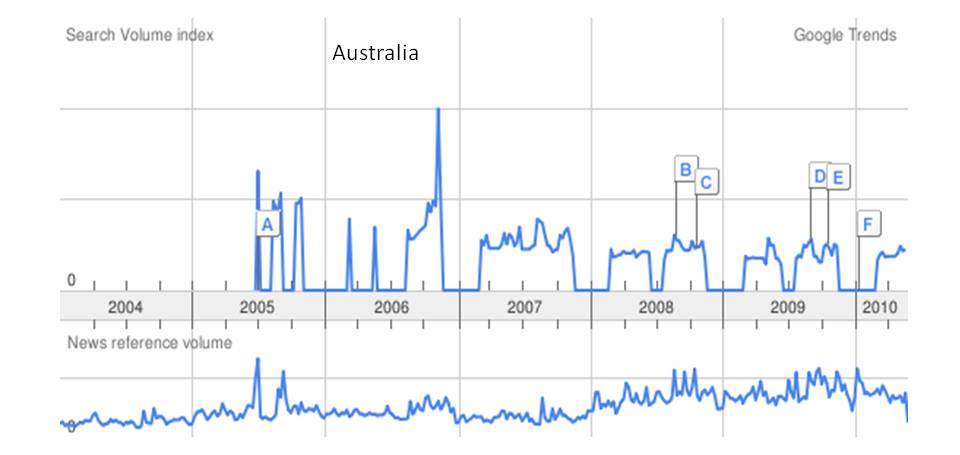
I have no idea what to make of India:

But what’s up out there? Are teachers just assigning a lot of homework on poverty all over the world?
Friday, May 21, 2010
What's a newspaper for?
We (Madura) recently launched a classified ad newspaper that reaches 400,000 poor rural households in Tamil Nadu. Our women borrowers can advertise their products, services and things they want to buy and sell free of charge while companies must pay. This is a hard to reach demographic that does not generally interact with print. One of our office locations used a women's day event that gathered 700 of our women borrowers to launch the paper in their area. I didn't attend this launch but our CEO reported to me that a very large number of women took the paper that was handed out and immediately used it to wrap up the snacks that were served to them.
(One useful statistic to put this in context is that about a third of our borrowers cannot read. Still....)
(One useful statistic to put this in context is that about a third of our borrowers cannot read. Still....)
Monday, May 17, 2010
What's Google? Is Obama a computer program?
I am increasingly convinced that poverty is a network problem. Poor people are less connected and linked in to the rest of the world on various dimensions. The resulting information poverty results in a poverty of opportunity and therefore economic poverty and the cycle goes on. I recently did a small survey for fun where I asked about 20 women from our self help group member base that are between 5th and 8th grade educated what the following four words meant to them:
Google
Obama
Microsoft
Manmohan Singh
The majority were flumoxed by Google. No idea they said. Microsoft is a computer and Obama, is it something to do with computers? Manmohan Singh was correctly answered by a handful (6 to be exact). Others asked: Is he a Hindi film actor? cricketer?
Facebook? YouTube? I didn't bother to ask.
We don't live in the same world.
Obama
Microsoft
Manmohan Singh
The majority were flumoxed by Google. No idea they said. Microsoft is a computer and Obama, is it something to do with computers? Manmohan Singh was correctly answered by a handful (6 to be exact). Others asked: Is he a Hindi film actor? cricketer?
Facebook? YouTube? I didn't bother to ask.
We don't live in the same world.
Monday, May 3, 2010
The Strength of Weak Ties
I have been thinking a lot about how to understand poverty from the point of view of the properties of the social network. In this context, I thought I would share with you a very important paper by sociologist Mark Granovetter written in 1973 called ‘The Strength of Weak Ties’ which he has more recently revisited in a new paper called ‘The Strength of Weak Ties: A Network Theory Revisited’. Here is an excerpt:
.....individuals with few weak ties will be deprived of information from distant parts of the social system and will be confined to the provincial news and views of their close friends. This deprivation will not only insulate them from the latest ideas and fashions but may put them in a disadvantaged position in the labor market, where advancement can depend, as I have documented elsewhere (1974), on knowing about appropriate job openings at just the right time. Furthermore, such individuals may be difficult to organize or integrate into political movements of any kind, since membership in movements or goal-oriented organizations typically results from being recruited by friends. While members of one or two cliques may be efficiently recruited, the problem is that, without weak ties, any momentum generated in this way does not spread beyond the clique. As a result, most of the population will be untouched. The macroscopic side of this communications argument is that social systems lacking in weak ties will be fragmented and incoherent. New ideas will spread slowly, scientific endeavors will be handicapped, and subgroups separated by race, ethnicity, geography, or other characteristics will have difficulty reaching a modus Vivendi.I share this because villages, which are typically poor by nature, are generally insular, tending to rely much more on strong ties with very few weak ties outside their village. Given this, one strategy Madura takes as an organization is to bring in products, services and events that foster ties across villages and to the urban economy. This may all sound like common sense but what is surprising, if you get into the models and workings of networks, is just how profound the consequences of a few weak ties can be. (I've spent the last five years thinking about this mostly in the context of the brain and it is interesting to note that the cerebral cortex, the outer layer of the brain where all the high level thinking gets done, is characterized largely by weak connections).
Subscribe to:
Posts (Atom)